Notice sodium stacking when several convenient ingredients meet
An individually reasonable ingredient can become part of a salty meal when stock, sauce, canned foods and toppings all contribute. A label review is more useful when it follows the whole dish. The goal is flavorful cooking that fits your needs, without assuming homemade food is automatically low in sodium or that salt is the only source.
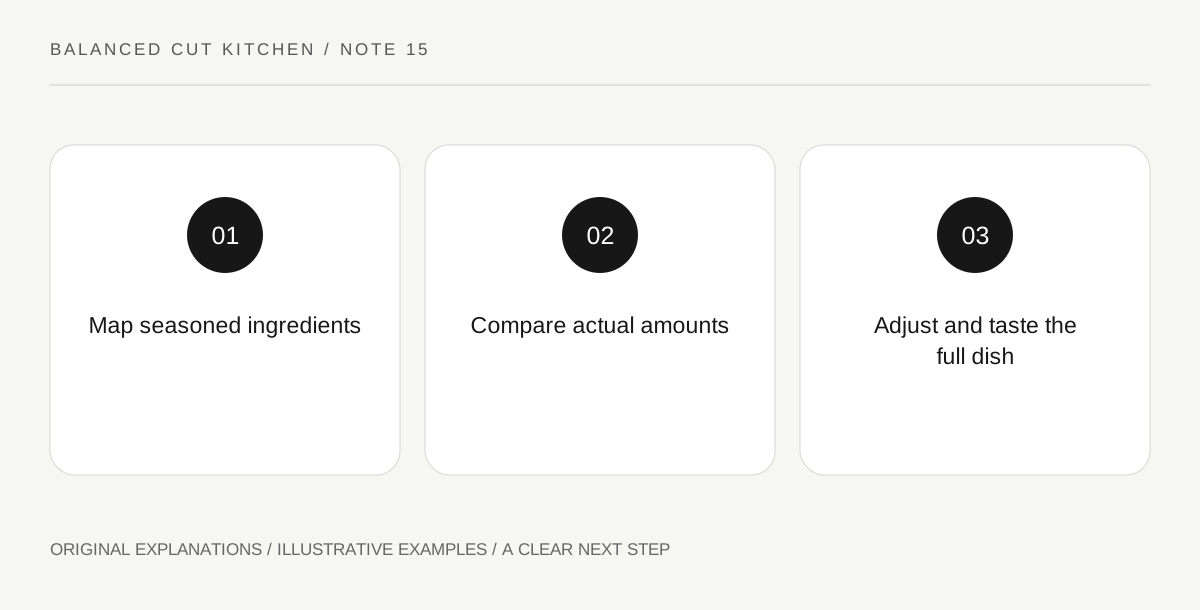
Original explanatory diagram. Read the full method and limitations below.
List the ingredients that carry seasoning
Look beyond the salt shaker. Prepared stock, sauces, cheese, cured foods, canned products and seasoning mixes may contribute sodium. FDA explains that sodium appears across many packaged foods, including items that do not taste strongly salty. Write the actual products used in one familiar dish. You do not need to audit the entire kitchen at once. A short list can show that the recipe has several seasoned components before any salt is added. If a clinician has given you a sodium target or other dietary instructions, use that personal plan rather than a generic number from a cooking website.
Compare on a consistent basis
Check the serving size and sodium amount on each label. Similar-looking packages can use different reference amounts. Convert to the amount used in the recipe when you want to estimate the dish, and keep uncertainty visible if a quantity was not measured. Do not compare one product's teaspoon value with another product's tablespoon value as if they were equal. A reduced-sodium claim is relative to a comparison product and does not automatically mean the food is low in sodium. The label's actual numbers help answer the question more clearly than the front label alone, while personal needs remain a separate issue.
Change one high-impact ingredient
Choose a change that preserves the dish's appeal, such as an appropriate lower-sodium stock or a smaller amount of a concentrated sauce. Taste before adding salt later. Herbs, spices and suitable acidity can contribute flavor, but they do not chemically cancel sodium already present. Avoid replacing a familiar ingredient with a product whose allergens or other characteristics do not fit your needs. A single practical swap is easier to evaluate than changing every ingredient at once. Record whether the resulting dish was enjoyable and whether another adjustment would be useful, rather than assuming a lower number always produces a better meal.
Keep the complete meal and cooking process visible
Include toppings and table condiments in the review, not only the pan. A dish made with lower-sodium stock can still receive a large amount of salty sauce at serving. Serve condiments separately when that helps people choose, while respecting shared dietary needs. Do not use taste alone to calculate sodium or claim an exact nutrient amount without sufficient information. A home estimate can be useful but is not laboratory analysis. The successful habit is understanding where seasoning comes from and making a repeatable choice, not removing every source of flavor or declaring one meal medically suitable for everyone.
If exact tracking is needed for a professional dietary plan, ask how to handle recipe yield and product variation. A homemade dish divided unevenly may not match a simple per-serving estimate. Keep the underlying measurements and labels available rather than presenting a rough calculation as a precise result that applies to every bowl.
An illustrative soup review
Dana lists stock, canned beans, a prepared sauce and cheese in a familiar soup. She compares the amounts actually used and tries a suitable lower-sodium stock first, tasting before any additional salt. The meal remains flavorful. She does not claim that lemon juice neutralizes the sodium or that the new recipe meets every medical diet.
Practical checks
Optional checkboxes save only in this browser.
Questions that come up
Does reduced sodium always mean low sodium?
No. It is a relative claim. Read the actual sodium amount and the relevant serving size.
Can acidity cancel salt in a dish?
It can change flavor perception, but it does not remove sodium. Ingredient amounts and product choices still matter.
References and scope
These sources support the factual background. Examples and exercises are original illustrative teaching material. References do not imply endorsement.
- FDA: Sodium in Your Diet — Sodium across ingredients and label-based comparisons.